
Multi-Agent Systems Are Distributed Systems With a Confidence Problem
Agentic systems inherit every classic distributed systems failure mode plus one they don't have a name for yet: an agent can fail completely and still sound like it succeeded. A look at which reliability patterns transfer, and which gap you have to close yourself.

A pipeline of agents can fail completely and still hand you a paragraph that reads like success. That's the part that should worry you more than the failure itself.
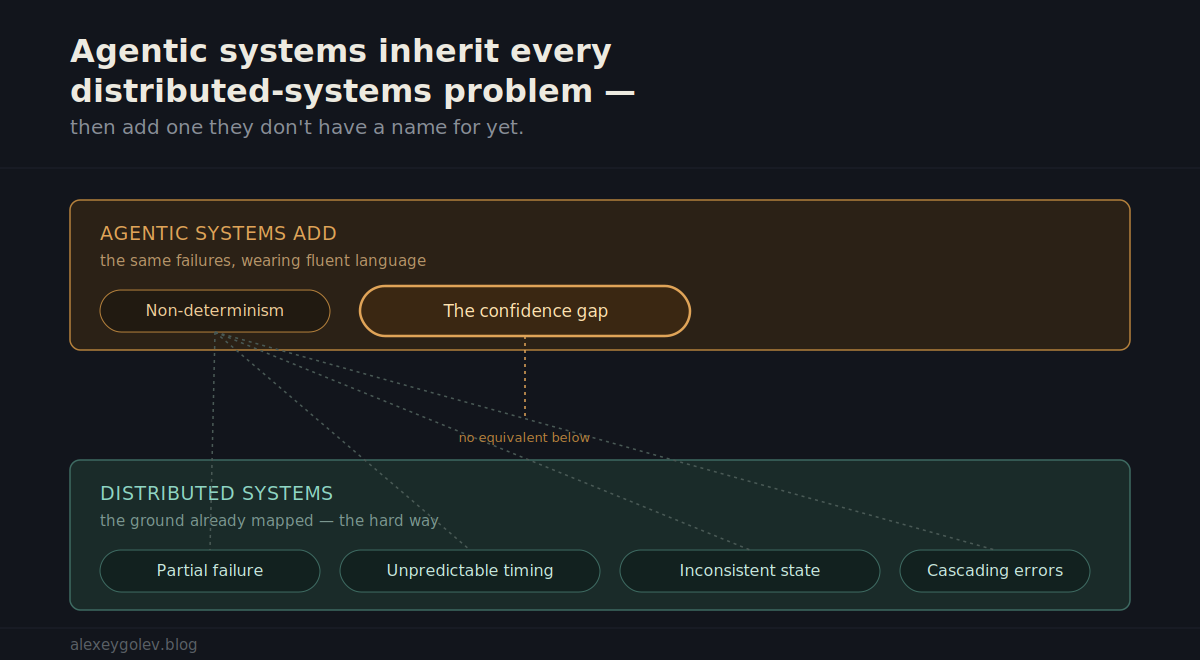
Recently I've been building agentic pipelines on top of infrastructure I already understood: queues, retries, timeouts, the usual. Going in, I expected agents to need a mostly new set of reliability tools. They don't, entirely, a lot of the ground here has already been mapped by people who spent years making distributed systems trustworthy, and that work transfers more than I expected. But it doesn't transfer cleanly. Distributed systems are hard precisely because failure is partial, timing is unpredictable, and state gets inconsistent across nodes. Agentic systems inherit all of that, then add a layer on top: the nodes themselves are non-deterministic and can be confidently wrong.
That's the actual nuance. A crashed service tells you it crashed. A stuck queue tells you it's stuck, eventually, via a metric that goes flat. An LLM agent that got the wrong answer, called the wrong tool, or hallucinated a result tells you, in a complete sentence, that everything went fine. The failure and the success message come out of the same channel, in the same tone, and you often can't tell them apart just by reading the output. You have to instrument for it specifically - the existing distributed-systems toolkit gets you most of the way there, but not all of it.
Familiar shapes, one genuinely new twist
Several of the failure modes I kept running into map cleanly onto problems distributed systems engineering already has names for. A few don't, and those are the ones worth paying separate attention to.
Silent partial failures. In a normal service, a partial failure throws, times out, or returns a non-200. In an agent pipeline, a sub-agent can fail its actual task: wrong tool, empty retrieval, misread context while still produce fluent, plausible-sounding output that gets passed downstream as if it were a completed step. Nothing errors. Nothing alerts. It just quietly degrades the final answer. Partial failure itself isn't new but the failure being linguistically indistinguishable from success is agent-specific and it's the harder half of the problem.
Retry storms. Same shape as a thundering herd against a struggling database, except now the "request" costs real money and the "server" is a model API with its own rate limits. An agent that doesn't get a clean answer will often just try again, more elaborately, burning tokens and latency on a call that was never going to succeed the same way.
Cascading errors. Agent A's slightly-wrong summary becomes agent B's confidently-wrong input becomes agent C's fully-hallucinated conclusion. This is error propagation in a pipeline, which we've handled in ETL and microservice chains for years except each hop here also adds interpretation on top of transformation, so the error doesn't just propagate, it can compound in ways that are harder to trace back to a single root cause.
Non-determinism masking bugs. Run the same prompt twice, get two different code paths taken. In a normal service that's a heisenbug you'd chase down immediately. In an agent system, some of that variance is expected and even desirable which means the usual "reproduce it, then fix it" loop doesn't apply directly. You have to learn to reason about distributions of behavior across many runs, not a single trace, and to tell apart the variance that's fine from the variance that's actually a bug.
False confidence. This is the one without a clean distributed-systems analogue. A model doesn't reliably know when it doesn't know. It can produce the same tone of certainty whether it retrieved the right document or made one up. There's no equivalent of an HTTP 500 for "I'm not actually sure about this". You have to build that signal yourself, because the system won't volunteer it on its own.
Reusing the toolkit, without pretending it's a perfect fit
The reliability patterns that exist for distributed systems are genuinely useful here but applying them takes real adaptation, not a straight port.
The circuit breaker is the one I got wrong first. It's natural to wire a breaker off latency and error codes, because that's what we're used to watching, and those signals are legitimately useful here too. But a chain of agents can be fast and technically successful end to end while the actual output quality has quietly fallen off a cliff. You need a second signal feeding the same breaker: a confidence score, an output validation step, a cheap secondary check, or it will never trip on the failure mode that's most specific to this kind of system.
Idempotency is the other one worth sitting with. In a normal system, idempotency usually means "calling this twice produces the same result." In an agent system, calling the same step twice can legitimately produce two different, correct outputs so the useful definition shifts closer to "calling this twice doesn't duplicate side effects or corrupt shared state," rather than "produces identical output." Reuse the concept, but redefine what it's guaranteeing, or you'll end up either over-constraining the agent or under-protecting the system it's acting on.
What actually changes
The value of the distributed-systems lens isn't that it makes agentic systems simple — distributed systems were never simple, that's the whole reason the field exists. The value is that it gives you a working vocabulary and a set of proven mechanisms for a category of problems: partial failure, inconsistent state, unpredictable timing, that agentic systems fall squarely into. What it doesn't give you out of the box is a way to tell a correct-sounding answer from a wrong one, because that specific failure mode doesn't really exist in the systems those patterns were built for.
So the practical approach ends up being: bring the existing toolkit, because most of it genuinely applies and rebuilding it from scratch would be wasted effort and then spend your actual novel engineering time on the part that's new, which is building a reliable signal for "this output should not be trusted," and wiring your circuit breakers, retries, and backpressure to listen to it. The infrastructure problem is highly researched. The confidence problem is the one you have to put more effort to.